

Review the information below for more information in response to frequently asked questions about the CSU Intergroup Dialogues Program.
General Information
What is the Intergroup Dialogue framework?
Intergroup Dialogue (IGD) is a well-established, research-based model that blends active learning with theory and knowledge of systems of oppression, social identities, and injustices to energize changemakers and promote action. Specifically, IGD facilitated conversations:
- encourage perspective-taking and empathic skills
- deepen participant understanding of systems of privilege and power
- expand awareness of our own roles in interpersonal, systemic and institutional oppression and liberation
- promote meaningful action in participants’ daily lives
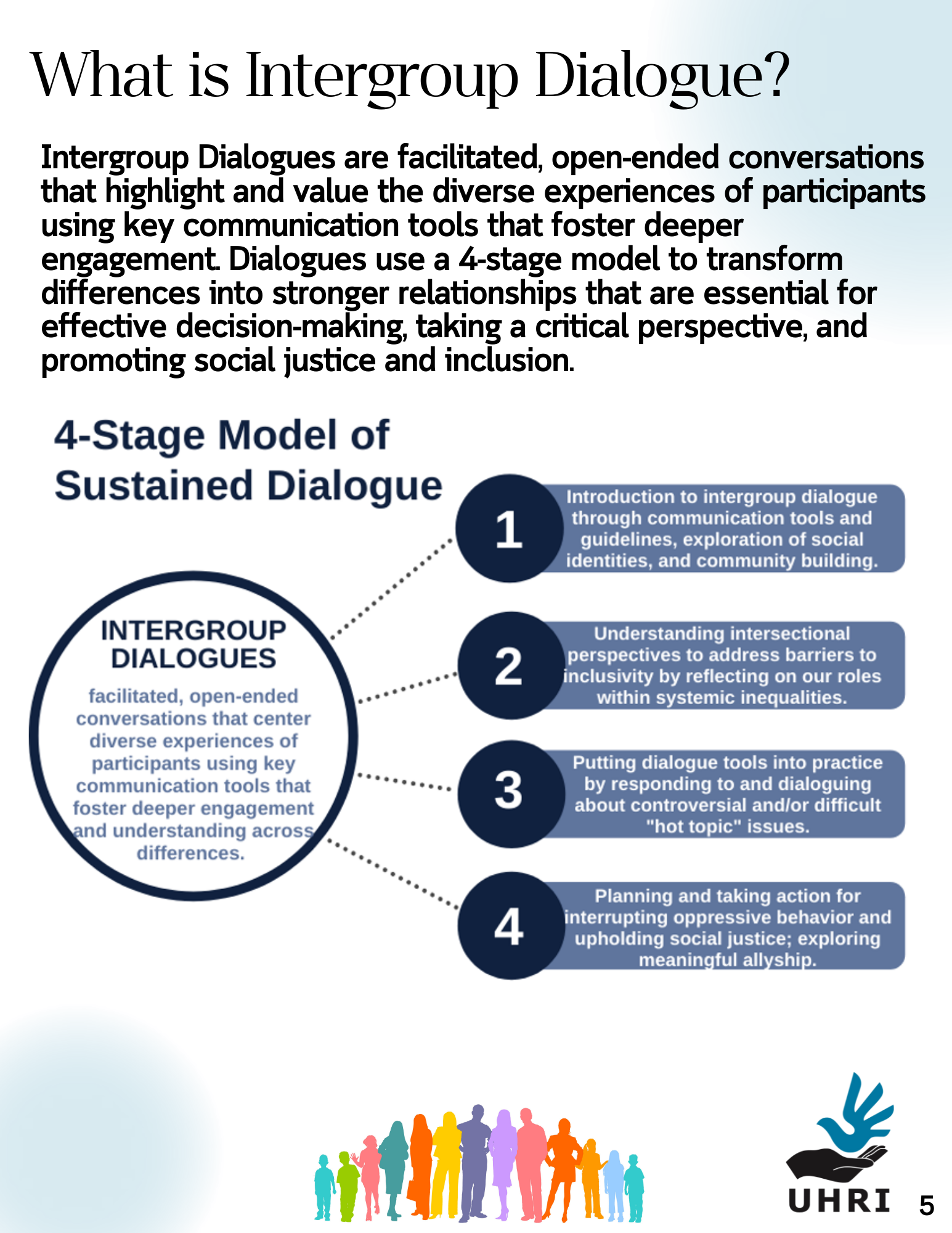
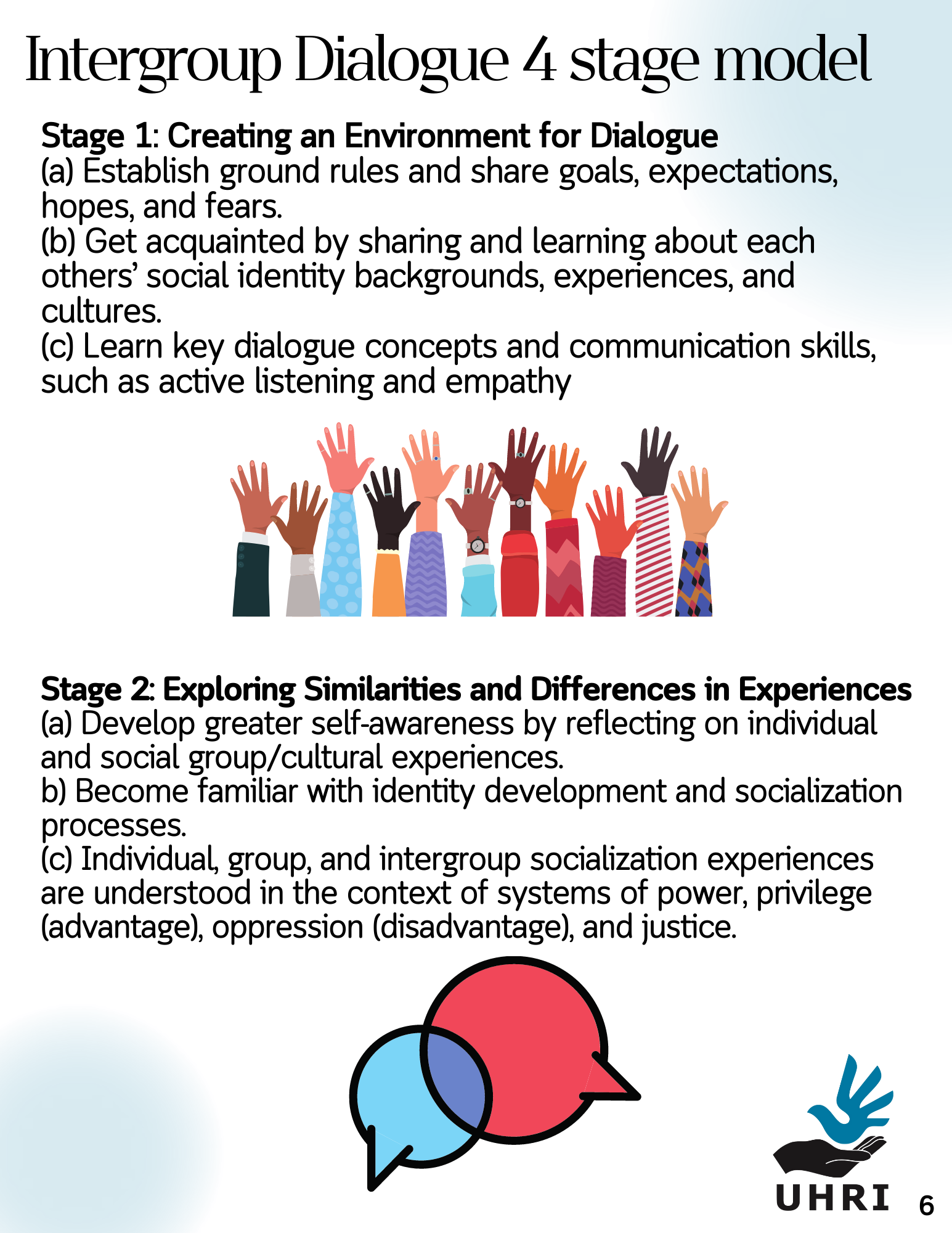
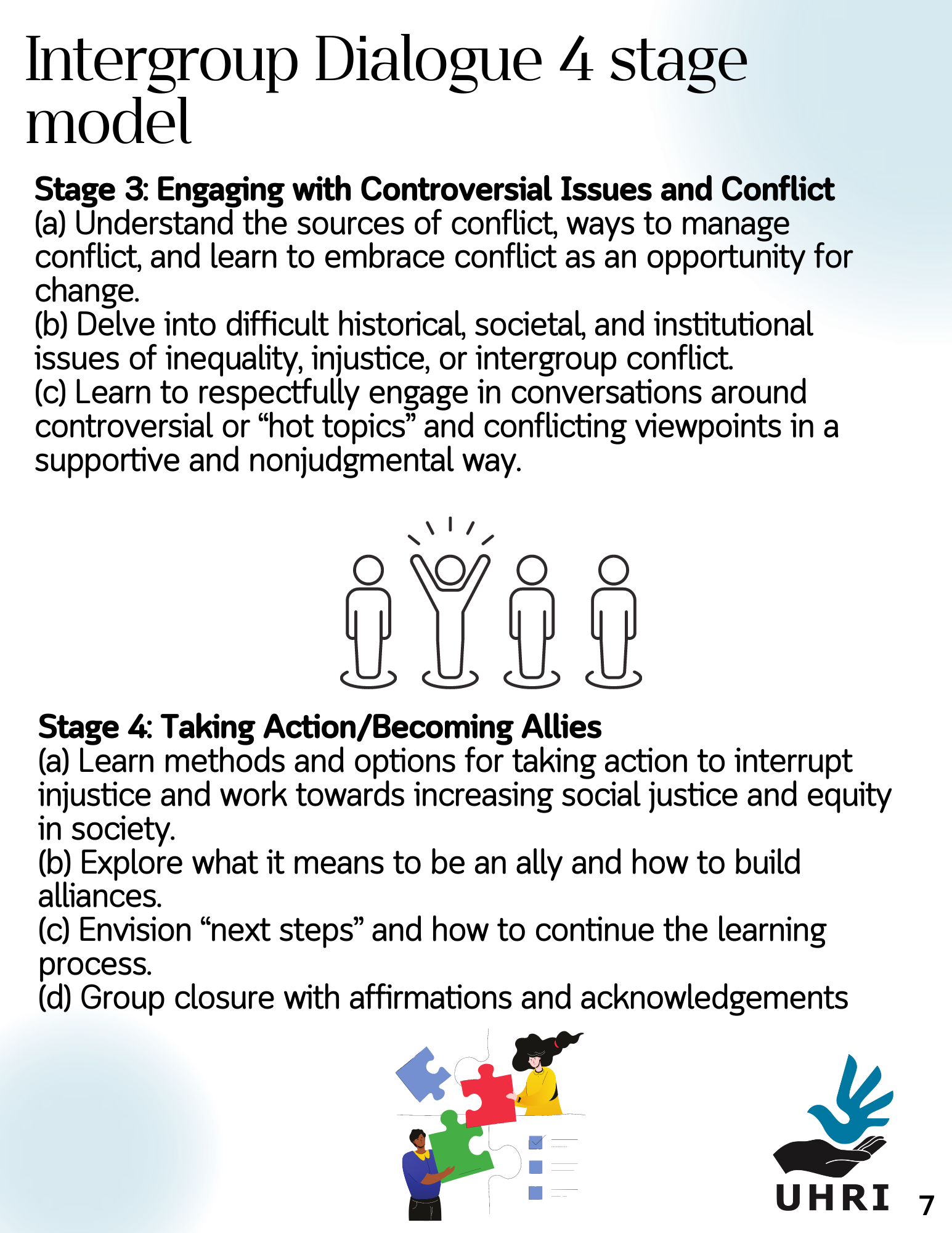
The IGD framework generates equity-focused transformative personal change, which can be applied to participants’ core environments, such as workplaces, community efforts, schools and more. IGD incorporates a four-stage model (developed at the University of Michigan, UCLA and other institutions) which promotes listening actively and self-reflecting on each other’s experiences, engaging in difficult conversations, and exploring meaningful actions that we can take for ourselves and our communities. Decades of research has shown that participation in IGD increases participants’:
- awareness of biases
- self-reflective skills
- comfort navigating difficult conversations and conflicts
Specifically in higher education settings, robust evidence on the application of IGD suggests successful outcomes in identity and ally development, attitudinal changes, critical consciousness raising, and action preparedness.
Eligibility & Application
Who can participate in the program?
The program is open to students, staff, and faculty in the 10 Southern California CSU campuses who are interested in improving graduation rates and impacting equity gaps on their campuses. You just have to be affiliated with a CSU campus as a student (full-time or part-time), staff or administrator, and faculty (full-time or part-time) and turn in an application to show your interest.
The program is open to students, staff, and faculty in the 10 Southern California CSU campuses who are interested in improving graduation rates and impacting equity gaps on their campuses. You just have to be affiliated with a CSU campus as a student (full-time or part-time), staff or administrator, and faculty (full-time or part-time) and turn in an application to show your interest.
Which CSU campuses are eligible to participate?
In the inaugural year of the program, we are targeting the program to 10 Southern California CSU campuses including the following: Channel Islands, Dominguez Hills, Fullerton, Long Beach, Los Angeles, Northridge, Pomona, San Bernardino, San Diego, and San Marcos.
How many spots are available for participants?
In the inaugural year of the program, we only have 35 spots available for participants across the 10 campuses. More spaces may become available in the future based on demand and funding.
What does the application entail?
The application asks you to share personal information such as demographics and contact details. Additionally, the application asks you to list your availability to decipher which workshop group you will be able to attend on a weekly basis starting in October. Lastly, we ask some questions about your experience and interest in topics related to intergroup dialogue. The application should take you about 10 minutes to complete and submit.
What happens once I submit the application by the stated deadline?
We have limited spots available for the program in this first year. Therefore, once you submit your application, you should plan to check the email address you provided by 9/26/22 for notification of acceptance into the program. If you are accepted to participate, please plan to join the first workshop at the time provided in the email during the week of October 3rd.
How were the final program participants selected for Year 1 of the program?
We received over 190 applications across the 10 campuses in less than 2 weeks of recruitment! We are incredibly grateful for the interest expressed by our Southern California CSU campuses to become better equipped in facilitating difficult conversations and to target graduation inequities on our campuses. In the inaugural year, we only have 35 spots available for participants across the 10 campuses. Therefore, we used a randomization protocol to account for representation from each of the campuses who applied. Please read below to learn more about how we reached the 35 acceptances from the large number of applications we received. We will keep all interested parties on our listserv to share future opportunities in the upcoming academic year and to share progress of the action projects that will be led by the inaugural cohort.
- Ensuring that each campus that applied has representation (note: CSUSM and CSUSD had 0 completed applications), all campuses with 5 or less applicants had all applicants accepted.
- For the remaining campuses, we sorted within each campus by Faculty, Staff and Student categories.
- We then randomized (using https://www.random.org/lists/) all applicants for that category (eg. CSUN faculty) and picked the top of each category for consideration.
- We then applied our discretion to the randomized groups to select a diverse pool of participants to honor the fidelity of the intergroup model (e.g nobody left as the one and only of an identity group, balance of gender identity, intentional inclusion of generally marginalized groups).
Program Logistics
Where will the program take place?
To allow for maximum accessibility, this program is entirely virtual. The fall workshop series will be conducted via Zoom and all subsequent meetings will be scheduled to meet via Zoom.
When does the program start and end?
The program will begin with the first facilitation training workshop during the Week of October 3rd, 2022. For the Fall semester, as a participant, you will be expected to participate in weekly facilitation workshops via Zoom (2-3 hours/session) for 8 total workshops, spanning a total of 20 hours of commitment. A full schedule of workshops will be shared with participants accepted into the program. One of the questions on our application asks you to confirm your availability to be able to attend all of the workshops. Your participation in the Spring semester will depend on the action project you decide to take on with other collaborators who also completed the facilitation training.
When will the trainings be held?
Trainings will be conducted in groups that meet at regularly scheduled times during the months of October and November 2022. There are several time slots available for potential training times. Applicants will indicate which times that they are available from the following time slots, and times will be scheduled based on majority availability:
- Mondays: 3pm-5pm
- Tuesdays: 9am-11am
- Tuesdays: 2:30pm-4:30pm
- Thursdays: 11am-1pm
- Thursdays: 5pm-7pm
- Fridays: 9am-11am
Who will lead the facilitation training in the Fall semester?
We are partnering with Universal Human Rights Initiative (UHRI), a non-profit organization that focuses on intergroup dialogue. UHRI offers facilitated intergroup dialogues as a means for teams to connect across diverse backgrounds and experiences. Their interactive dialogues promote specific communication tools that aid participants in engaging with people they might not otherwise feel connected to. The dialogues incorporate a four-stage model (research based, developed at the University of Michigan and UCLA) promotes comfort in listening actively, self-reflecting on one’s own experience, engaging in difficult conversations, and exploring meaningful actions to take for oneself and for one’s community. More about UHRI facilitators who will be leading the dialogue facilitation training can be found at this link.
Do I have to sign up for the 2-semester program or can I just do the facilitation training?
You must be available and willing to participate in the entire program, the facilitation training and action project implementation. Putting your facilitation skills into action in the spring semester is key to reducing equity gaps in the CSU, therefore, a critical part of the program.
What happens if I miss one of the facilitation training workshops in the Fall?
Sustained dialogue practice is critical to gaining and practicing facilitation skills in IGD, therefore, it is pertinent you attend every workshop session. With advance notice, we can try to make accommodations if you miss just one workshop. You cannot miss more than a workshop in order to receive your certificate in facilitation and your incentive.
How can participants communicate with program facilitators?
Please email us at CSUdialogues@gmail.com. Our program coordinator will get back to you or connect you with one of the faculty members who are leading the program.
Participation Incentives
What are the incentives for participating?
In addition to the monetary incentive of $350 at the end of each semester ($700 total for the year), you will also receive a certificate for intergroup dialogue facilitation from the Universal Human Rights Initiative. In putting your facilitation skills into action, you will engage in coalition building with students, staff, and faculty from various CSU campuses. Intergroup dialogue is also a great opportunity for your professional, community, and personal development!
I am a student at a Southern California CSU campus. Can I get course credit for participating?
Please see above for the incentives of participating in the program. You will not receive course credit for participating, however, you will attain key IGD facilitation skills that can be applicable to your current role as a student and in future career goals and opportunities you embark on.
I am a staff member. Can I get proof of participation to share with my supervisor?
Participants will be completing the training in small groups of 12-13 in workshops that are co-facilitated by two trained IGD facilitators. We will keep track of your participation and progress and provide you with whatever proof you need to share with your supervisor to count towards your work commitments or otherwise.

